
Presented by Charles & Linda Raabe
Mactan Island, The Philippines
© 2008 All Rights Reserved
This page will not be a
"how to" attempt but one of encouraging you to be creative and break
away from the typical "flower garden" arrangements that most aquariums,
including mine, are landscaped as. Of course, the aquarium's dimensions
are either going to restrict you or allow you a wide range of options.
The typical dimensions of an aquarium are very limiting with their
normally narrow and tall square shape which does not leave much room
for creativity. As such, if it is not too late and you have not
purchased the tank yet, I would like to suggest that a much wider
dimension be considered, the depth of view and
landscaping possibilities are much more open to say the least.
Length is also an important consideration as well. Besides allowing
much more creativity, most, if not all fish placed within our systems
require horizontal swimming room more so than depth provided by heigth.
A long, wide aquarium also provides much more territory that fish can
stake out as their own thus reducing conflicts over who owns the
eighteen inch wide section of a typical aquarium. For my next aquarium,
I will not settle for anything less than 36 inches wide and 6 to 8 feet
long, wider if possible. The following links will hopefully
inspire you towards a creative and more realistic landscape.
Aquascaping the Marine Aquarium - A quick simple article on some things to take into consideration
Aquascaping with insulation foam - Another creative method for use as either a background or as an actual building block.
A Planted Aquarium - Lets not forget this option since I have yet to see a reef that "plants" were not a major component of.
Showpiece Items - Eye candy for the Aquarium - Placement tips and species selections
Biotopes - The recreation of specific reef habitats.
Aquascaping the Reef Aquarium - A short "how to" article.
Aquascaping the Marine Aquarium - A quick simple article on some things to take into consideration
Aquascaping with insulation foam - Another creative method for use as either a background or as an actual building block.
A Planted Aquarium - Lets not forget this option since I have yet to see a reef that "plants" were not a major component of.
Showpiece Items - Eye candy for the Aquarium - Placement tips and species selections
Biotopes - The recreation of specific reef habitats.
Aquascaping the Reef Aquarium - A short "how to" article.
A few natural examples taken from the Reef Tour
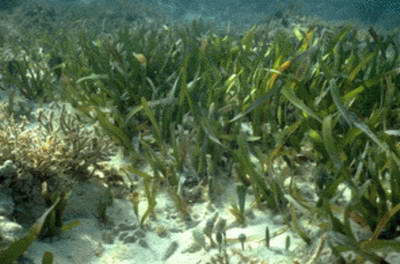 Sea grass
- While not normaly used as a show tank display, such an environment
would be an excellent refugium idea. Besides having the plant life
uptaking nutrients, the habitat that the sea grass provides can create
a little world unto itself with multitudes of other life forms that
will also process nutrients. Their reproduction will also provide the
main show tank with a constant supply of live foods as well. All of
this keeps with what I believe should be the concept of keeping
with the true meaning of the world reef, which for me, means diversity
of life.
Sea grass
- While not normaly used as a show tank display, such an environment
would be an excellent refugium idea. Besides having the plant life
uptaking nutrients, the habitat that the sea grass provides can create
a little world unto itself with multitudes of other life forms that
will also process nutrients. Their reproduction will also provide the
main show tank with a constant supply of live foods as well. All of
this keeps with what I believe should be the concept of keeping
with the true meaning of the world reef, which for me, means diversity
of life.
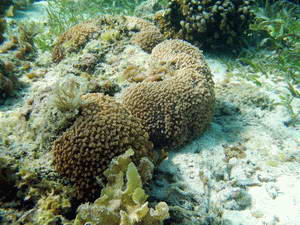 Sea grass bowls - Within sea grass beds, there are quite a
number of natural depressions that during the low tides, are just deep
enough to retain enough water to allow a variety of coral species to
thrive there as well. Not to mention a great many other permanent
residents such as small gobys, shrimp, crabs and of course, the usual
sandbed occupants such as worms, foraminiferans, snails and too many
more to mention.
Sea grass bowls - Within sea grass beds, there are quite a
number of natural depressions that during the low tides, are just deep
enough to retain enough water to allow a variety of coral species to
thrive there as well. Not to mention a great many other permanent
residents such as small gobys, shrimp, crabs and of course, the usual
sandbed occupants such as worms, foraminiferans, snails and too many
more to mention.
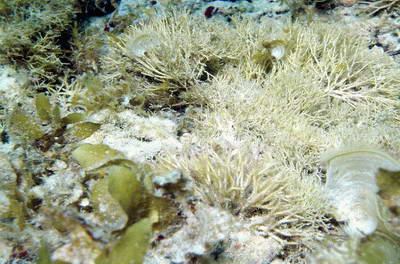 Macro Algae covered Rock
- Such areas make up great expanses of area that I feel does the
majority of nutrient capture from shore based run off that makes it
possible for the nearby shore fringing coral reefs to exsist. I would
love to see exporters keep such live rock intact with its macro algae
when collected and shipped overseas. The diversity of life forms that
can be found living with the shelter of such macro algae is truly
amazing. I can and do spend hours upon hours with a single sprig of
macro algae under a dissecting scope being astounded by just how much
life can be found in such a small world. If you have gone through my hitch hiker pages,
the vast majority of the animals shown have come from just such live
rock. Just as the SeaGrass habitats provide for, these macro algae rock
habitats would also make for an excellent refugium as well as a show
display. Even in such algae dominated areas, there are a good many
corals to be found scattered in amongst it all. Most notably, the
porites and pavona species.
Macro Algae covered Rock
- Such areas make up great expanses of area that I feel does the
majority of nutrient capture from shore based run off that makes it
possible for the nearby shore fringing coral reefs to exsist. I would
love to see exporters keep such live rock intact with its macro algae
when collected and shipped overseas. The diversity of life forms that
can be found living with the shelter of such macro algae is truly
amazing. I can and do spend hours upon hours with a single sprig of
macro algae under a dissecting scope being astounded by just how much
life can be found in such a small world. If you have gone through my hitch hiker pages,
the vast majority of the animals shown have come from just such live
rock. Just as the SeaGrass habitats provide for, these macro algae rock
habitats would also make for an excellent refugium as well as a show
display. Even in such algae dominated areas, there are a good many
corals to be found scattered in amongst it all. Most notably, the
porites and pavona species.
 This is but one of a great many examples of coral formations,
groupings that I see on the natrual reefs here. In due time, I plan to
add quite a few examples of how and where corals grow to give you an
idea of the great variations we can try to emulate within our display
aquariums. Species selection is of great importance when doing so.
Again, if you take a close look at the species living in such a tightly
packed wall as shown in the above photo, it will give you a good idea
of how such a biotope can be achieved.
This is but one of a great many examples of coral formations,
groupings that I see on the natrual reefs here. In due time, I plan to
add quite a few examples of how and where corals grow to give you an
idea of the great variations we can try to emulate within our display
aquariums. Species selection is of great importance when doing so.
Again, if you take a close look at the species living in such a tightly
packed wall as shown in the above photo, it will give you a good idea
of how such a biotope can be achieved.
The Reality of a Glass Box - While I am sure that most of us reef keeping fanatics would love to be able to have and maintain all of the diversity of life found within any given area of a natural reef, there is one, great, limiting factor that we have to contend with, and thats the simple fact that even with the largest of aquariums, they are in relative terms compared to the expanses of a reef, extremely small, confined spaces.
On a natural reef, any herbivore grazers, or predators tend to take a nip here, a bite there, and move on. Thus giving that area a good deal of time to recover before the next nip and bite occurs. That and having an oceans worth of plankton being washed over such areas, constantly having multitudes of life forms dropping out of the plankton to colonize any new territory, how ever small, that nips and bites open up. Something that is highly unlikely to happen within a small glass box. As such, we have no choice but to place limits on such animals that do the nipping and biting within our aquariums. Having a wrasse, crab or any predator confined in such a small area will quickly deplete any life forms that are surviving and living on our substrates (rock/sand). Which is why I insist on placing any rock that I collect into a small holding tank for a few days to allow me to look it over for any obvious predators that if allowed loose into my aquarium, would have the same effect as tossing a wolf into a pen full of sheep. Within a week or two, you will end up with a very fat wolf standing in a sheep free pen. The only way that I know of to get around such a scenario is to have an open loop to a tropical ocean to get the constant influx of new planktonic life forms or by limiting / removing all possible predators. While doing such removals may seem to go against the whole concept of "diversity", it is simply a fact of aquarium life that we must deal with to maintain any semblance of diversity. If not, you will quickly end up with nothing more than a bunch of corals parked on top of some coralline encrusted rocks and thats it. Not something that I can honestly call a "reef" aquarium, doing so, would to me, be the same as putting a bunch of tropical potted plants on the back porch and claiming that you have a rain forest. Besides, I am willing to bet that you have at one time noticed a tiny "critter" growing or crawling about and were thrilled at the sight. Why not take the effort to encourage as many of those "critters" as you can? It really does add so much more to the enjoyment of "Reef" keeping.
Sea grass
- While not normaly used as a show tank display, such an environment
would be an excellent refugium idea. Besides having the plant life
uptaking nutrients, the habitat that the sea grass provides can create
a little world unto itself with multitudes of other life forms that
will also process nutrients. Their reproduction will also provide the
main show tank with a constant supply of live foods as well. All of
this keeps with what I believe should be the concept of keeping
with the true meaning of the world reef, which for me, means diversity
of life.
Sea grass bowls - Within sea grass beds, there are quite a
number of natural depressions that during the low tides, are just deep
enough to retain enough water to allow a variety of coral species to
thrive there as well. Not to mention a great many other permanent
residents such as small gobys, shrimp, crabs and of course, the usual
sandbed occupants such as worms, foraminiferans, snails and too many
more to mention. Macro Algae covered Rock
- Such areas make up great expanses of area that I feel does the
majority of nutrient capture from shore based run off that makes it
possible for the nearby shore fringing coral reefs to exsist. I would
love to see exporters keep such live rock intact with its macro algae
when collected and shipped overseas. The diversity of life forms that
can be found living with the shelter of such macro algae is truly
amazing. I can and do spend hours upon hours with a single sprig of
macro algae under a dissecting scope being astounded by just how much
life can be found in such a small world. If you have gone through my hitch hiker pages,
the vast majority of the animals shown have come from just such live
rock. Just as the SeaGrass habitats provide for, these macro algae rock
habitats would also make for an excellent refugium as well as a show
display. Even in such algae dominated areas, there are a good many
corals to be found scattered in amongst it all. Most notably, the
porites and pavona species.
This is but one of a great many examples of coral formations,
groupings that I see on the natrual reefs here. In due time, I plan to
add quite a few examples of how and where corals grow to give you an
idea of the great variations we can try to emulate within our display
aquariums. Species selection is of great importance when doing so.
Again, if you take a close look at the species living in such a tightly
packed wall as shown in the above photo, it will give you a good idea
of how such a biotope can be achieved. The Reality of a Glass Box - While I am sure that most of us reef keeping fanatics would love to be able to have and maintain all of the diversity of life found within any given area of a natural reef, there is one, great, limiting factor that we have to contend with, and thats the simple fact that even with the largest of aquariums, they are in relative terms compared to the expanses of a reef, extremely small, confined spaces.
On a natural reef, any herbivore grazers, or predators tend to take a nip here, a bite there, and move on. Thus giving that area a good deal of time to recover before the next nip and bite occurs. That and having an oceans worth of plankton being washed over such areas, constantly having multitudes of life forms dropping out of the plankton to colonize any new territory, how ever small, that nips and bites open up. Something that is highly unlikely to happen within a small glass box. As such, we have no choice but to place limits on such animals that do the nipping and biting within our aquariums. Having a wrasse, crab or any predator confined in such a small area will quickly deplete any life forms that are surviving and living on our substrates (rock/sand). Which is why I insist on placing any rock that I collect into a small holding tank for a few days to allow me to look it over for any obvious predators that if allowed loose into my aquarium, would have the same effect as tossing a wolf into a pen full of sheep. Within a week or two, you will end up with a very fat wolf standing in a sheep free pen. The only way that I know of to get around such a scenario is to have an open loop to a tropical ocean to get the constant influx of new planktonic life forms or by limiting / removing all possible predators. While doing such removals may seem to go against the whole concept of "diversity", it is simply a fact of aquarium life that we must deal with to maintain any semblance of diversity. If not, you will quickly end up with nothing more than a bunch of corals parked on top of some coralline encrusted rocks and thats it. Not something that I can honestly call a "reef" aquarium, doing so, would to me, be the same as putting a bunch of tropical potted plants on the back porch and claiming that you have a rain forest. Besides, I am willing to bet that you have at one time noticed a tiny "critter" growing or crawling about and were thrilled at the sight. Why not take the effort to encourage as many of those "critters" as you can? It really does add so much more to the enjoyment of "Reef" keeping.